PuzzlesGuide
What is a calendar puzzle game?
Short answer
A calendar puzzle is a logic puzzle played on a calendar grid. There are two kinds: date boards, where you cover every square except today's date, and scheduling puzzles like Save Friday, where you fit a week of meetings so nobody is double-booked and Friday afternoon stays free.

Key takeaways
- Two different puzzles share the name: a physical date board and a scheduling puzzle on your phone.
- Both are packing puzzles. Every piece has to fit, and no two pieces can overlap.
- A scheduling puzzle adds people: one colleague can't be in two meetings at the same time.
- In Save Friday, every week from week 5 on has exactly one way to save Friday, and the Daily Week is the same for everyone.
- The quickest way to get better is to place the most constrained meeting first.
What are the two kinds of calendar puzzle?
When people search for a "calendar puzzle", they usually mean one of two things.
The first is a date board: a small wooden or acrylic tray printed with the months and the numbers 1 to 31, plus a set of flat pieces. Each day, you arrange the pieces so they cover everything except today's month and date. The target changes every day, so the same board gives you a new puzzle every morning. When you're stuck, though, nothing on the board tells you how close you are.
The second is a scheduling puzzle. The grid is a work week, the pieces are meetings, and on top of the rule about space there's a rule about people. Save Friday, the game we make, is this kind.
We make Save Friday, so this comparison isn’t neutral.
| Date board | Scheduling puzzle (Save Friday) | |
|---|---|---|
| The grid | Months and dates | Monday to Friday, by the hour |
| The pieces | Flat shapes | Meetings of 1 to 4 hours |
| The goal | Leave today's date uncovered | Place every meeting and keep Friday afternoon free |
| Extra rule | None | Nobody can be in two meetings at once |
| New puzzle | Every date | Every day (the Daily Week), plus 30 campaign weeks |
| Where you play | On a table | On iPhone |
How does a scheduling puzzle work?
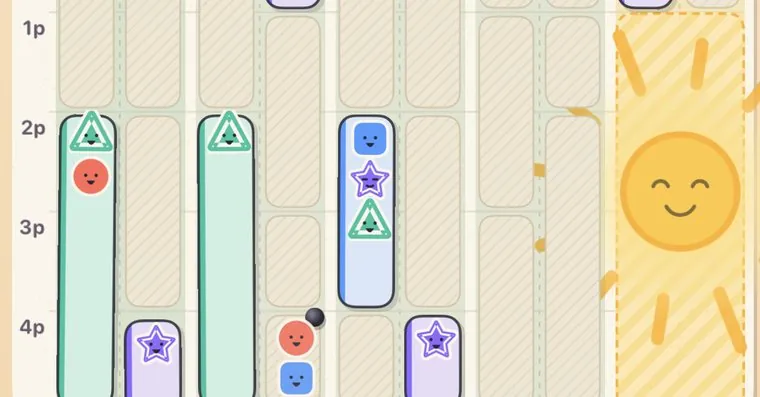
In Save Friday, you drag meetings from your inbox into a calendar that runs from Monday to Friday. A few rules turn it into a puzzle rather than a chore:
- A meeting is a block of 1 to 4 hours. It sits in one day and one room, and it never rotates.
- The dots on a meeting are people. Each colleague has a color and a shape, so you can tell them apart without relying on color alone.
- Nobody can be in two places at once. If Maya is in a meeting at 10 on Tuesday, she can't be in another one at 10 on Tuesday, even in the other room. The game flags a double-booking right away, and you can't finish the week until it's fixed.
- Some slots are already taken. Hatched cells mean another team has the room, and locked meetings are fixed in place. Neither of them moves.
- Friday afternoon is the sun zone. Keep it empty and you save Friday.

Each week gives up to three stars: one for a planned week, two for a saved Friday, and three for a clean save, which means saving Friday within the move target and without hints.
Why is it harder than it looks?
Two rules pull against each other. Space says a meeting needs a free slot that's long enough. People say that slot also has to be free for everyone in the meeting. A slot can look perfect and still be wrong, because someone in that meeting is busy at the same hour in the other room.
There's also no slack. From week 5 on, the meetings have to fill every free hour outside Friday afternoon, exactly. A meeting that looks fine early on can make the week impossible five moves later. That's why Save Friday has a forecast cloud: after every move, the game checks whether Friday can still be saved from where you are. If it can't, a cloud covers the sun until you undo.
Computer scientists have a name for this kind of problem. It's a constraint satisfaction problem: a set of choices, each limited by rules, where you need an answer that breaks none of them. The "fill every square exactly once" part is a classic called exact cover, the problem Donald Knuth's Dancing Links algorithm was built to solve. You don't need any of that to play, but it explains why a five-day calendar can keep you thinking.
How do you get better at calendar puzzles?
These tips follow the order our own solver works in.
- Start with the most constrained meeting. A meeting with three or four people, or a long one, has the fewest places it can go. Place it first.
- Place the busiest people's meetings first. If one colleague is in four meetings, their week is the tightest. Sort them out before anyone else.
- Look for gaps that only one meeting can fill. A 3-hour hole next to a locked event might fit just one meeting in your inbox. That's a forced move, so take it.
- Check the other room. Most double-bookings happen across rooms, at the same hour on the same day.
- Trust the cloud and undo freely. Undo is free and unlimited. When the cloud shows up, step back until the sun returns instead of pushing on.
What is the Daily Week?
The Daily Week is one new Save Friday puzzle a day. It's the same for every player, and it's free. It changes at midnight, your local time. Monday's week is the gentlest, the weeks get harder as the days go on, Saturday's is the toughest, and Sunday eases off a little.
When you finish, you can share a result card with your time, moves and stars. It never shows where the meetings went, so you can compare with friends without spoiling anything. The daily puzzle is on the Daily Week page. If you're curious how a Daily Week gets built and tested before it reaches you, we wrote it up in How a Daily Week is made.
Where can you play a scheduling puzzle?
Save Friday is coming soon to iPhone (iOS 17 or later). The Daily Week and weeks 1 to 10 are free. The Holding and the rest of the game open with one purchase, The Whole Office: $8.99 in the US, and the App Store shows the price in your country. There are no ads, it works offline, and you don't need an account. The full rules, with pictures, are on How to play.
The Daily Week will be free. Save Friday is coming soon to iPhone.
 Coming soon to the App Store
Coming soon to iPhone. The Daily Week and weeks 1–10 are free.
- No ads
- No tracking
- One purchase, no subscription
More questions
-
Is a calendar puzzle the same as a date puzzle?
Not always. "Calendar puzzle" covers both date boards, where pieces leave today's date uncovered, and scheduling puzzles, where you place meetings in a week. Save Friday is a scheduling puzzle.
-
Does every Save Friday week have a solution?
Yes. The generator builds each week from a finished answer, so a way to save Friday always exists. From week 5 on, a solver also checks that there's exactly one.
-
Can I play Save Friday offline?
Yes. The campaign and the Daily Week both work without the internet, and you don't need an account.
-
Is Save Friday free?
The Daily Week and weeks 1 to 10 are free. The Holding and the rest of the game open with one purchase, The Whole Office: $8.99 in the US, and the App Store shows your local price. There are no ads.
Sources and checks
- Constraint satisfaction problemWikipedia
- Exact coverWikipedia
- Dancing LinksDonald E. Knuth, arXiv (cs/0011047), 2000
- Screenshots come from the real game. They’re cropped, never edited.
Spotted a mistake? Write to support@savefriday.app. Every fix gets a dated note here. How we write