How it’s madeGuide
How a Daily Week is made
Short answer
Every Daily Week in Save Friday comes from a generator: it lays out a solved week, takes it apart, and keeps it only if exactly one arrangement saves Friday. Then a simulated beginner plays it 100 times, and it ships only if the bot's success rate fits that weekday.

Key takeaways
- The answer comes first. The generator starts from a finished week and works backwards.
- A solver counts the ways to save Friday and stops at two. Only weeks with exactly one survive.
- The date is the seed, so every iPhone gets the same week on the same date, and more than a year of Daily Weeks ships inside the app.
- Before a week ships, a simulated beginner plays it 100 times. Monday's target solve rate is 90%; Saturday's is 28%.
- No level designer picks the weeks by hand, and no AI model writes them. It's ordinary, deterministic code.
Why does every Daily Week have exactly one answer?
Because a shared puzzle is only a fair race if there's one way to finish it. With one answer, a time of 0:47 means the same thing on every phone, and nobody beat you by stumbling on an easier shortcut. One answer also keeps the puzzle about logic, not luck: every meeting has a reason to be where it ends up, so you can work it out instead of guessing.
It's also why the result card you share shows your time, moves and stars, but never where the meetings went. Your friends can see how your week went without seeing the answer.
How does the generator build a week?
In four steps.
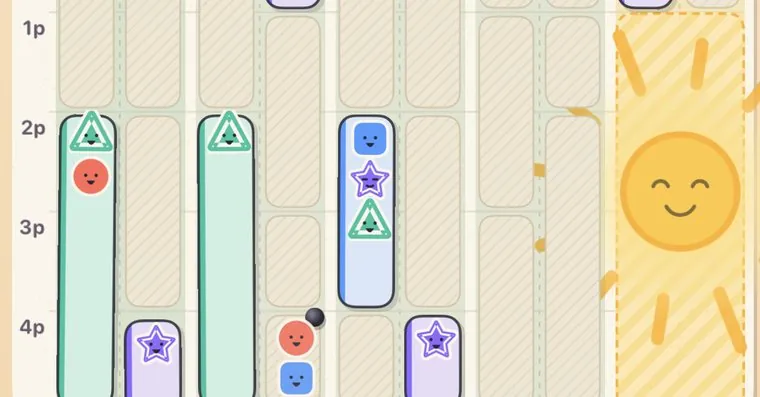
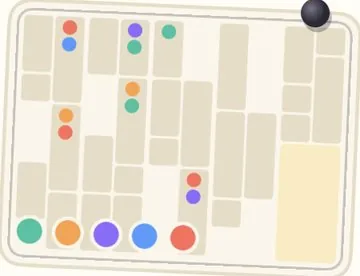
- Lay out the answer. The generator takes an empty week, leaves Friday afternoon out, and cuts each room's free hours into pieces of one to four hours. Some pieces become meetings. The rest become booked hours: another team has the room.
- Staff it. Each meeting gets one to four people, without double-booking anyone in the answer. The generator prefers people who already have a meeting at the same hour in the other room, because that's what makes a week tricky. Everyone gets at least two meetings.
- Count the answers. A solver tries to rebuild the week from scratch, starting with the most constrained meeting, and counts the ways to save Friday. It stops as soon as it finds two. Swapping two identical meetings doesn't count as a new answer.
- Break the tie. If there are two answers, the generator adds a constraint that rules out the second one, usually by adding a person who clashes only in the other arrangement, or by locking a meeting in place. Then it counts again. After 30 rounds without a unique week, it starts over from a new seed.
The solver is a depth-first search, the textbook backtracking approach. It uses bitmasks to track which cells are taken and which person is busy at which hour on which day. It's small and fast, and the same idea powers the forecast cloud you see in the game (more on that below).
How does every iPhone get the same week?
The date is the seed. For a Daily Week, the generator turns the text "savefriday:v1:" plus the date, say 2026-11-02, into a 64-bit number using FNV-1a, a simple, well-documented hash. That number seeds SplitMix64, a fast pseudorandom generator published by Guy Steele, Doug Lea and Christine Flood in 2014. The whole build uses integer math only, so the same input gives the same week on any device. A test in our suite checks the fingerprints of known weeks, so a code change can't quietly alter them.
In practice, your phone doesn't even have to do that work. More than a year of Daily Weeks, counting from launch day, is generated ahead of time and ships inside the app, about 190 KB in total. That's why the Daily Week works offline. After that, the app builds each week from the same seed. The week changes at midnight by your phone's local date, and Daily Week #1 is launch day.
How do you test a puzzle before anyone plays it?
With bots. Our test suite has several simulated players, and the one that matters most for the Daily Week is the beginner. It picks a meeting at random, drops it where it fits most snugly, makes a random slip 15% of the time and can undo up to five times. It stands in for a newcomer: it looks ahead only as far as the game's own warnings.
The beginner bot plays each candidate week 100 times, and its solve rate has to land in the band set for that day of the week:
| Day | Target solve rate for the beginner bot |
|---|---|
| Monday | 90–100% |
| Tuesday | 75–100% |
| Wednesday | 60–85% |
| Thursday | 45–70% |
| Friday | 35–60% |
| Saturday | 28–53% |
| Sunday | 40–65% |
Fridays and Saturdays get one more check: a beginner who follows the forecast cloud, and undoes when it appears, has to save Friday at least 93% of the time over 30 runs. Hard days are allowed to be hard, but not unfair. The generator tries up to 40 seeds for each date (80 on Fridays and Saturdays) and takes the first week that passes. If none does, it ships the closest one.
What did the bots teach us?
Three things we changed after watching the bots.
- The cloud matters more than we expected. In one October test of a Saturday week, the beginner bot saved Friday 22% of the time on its own and 98% of the time when it followed the cloud and undid. That's why the extra check on hard days is about the cloud.
- 40 runs weren't enough. Our first picker played each candidate 40 times, and a lucky streak could let a hard week through. We moved to 100.
- The campaign got a curve of its own. Each week of the year has a target band for the beginner bot. Within a part, the weeks climb to a peak and then give you a breather, and each part is harder than the last. A test fails the build if the curve breaks.
These are simulations, not people. The game doesn't send us any play data, so for now we tune against the bots and against what players tell us when they write in.
What does the forecast cloud do?
After every move, a solver checks in the background whether a Friday-saving finish still exists from the current board. If it doesn't, a cloud covers the sun until you undo. On the heaviest weeks in the game, that check took at most 0.2 milliseconds per position in our tests on a Mac, so it never holds up your next move. If you'd rather work it out alone, you can switch the cloud off for Expert mode in Settings.
Want to see it in action? The Daily Week is on its own page, the rules are on How to play, and if you'd like the bigger picture of this kind of game, read What is a calendar puzzle game? Save Friday is coming soon to iPhone.
A new Daily Week every day, free. Save Friday is coming soon to iPhone.
 Coming soon to the App Store
Coming soon to iPhone. The Daily Week and weeks 1–10 are free.
- No ads
- No tracking
- One purchase, no subscription
More questions
-
Is the Daily Week the same for everyone?
Yes. Everyone gets the same week on the same date. It changes at midnight, your local time.
-
Can a Daily Week be impossible?
No. Every week is built from a finished solution, and a solver confirms there's exactly one way to save Friday before the week ships.
-
Why is Saturday's Daily Week harder than Monday's?
By design. Difficulty climbs through the week: the beginner bot's target solve rate goes from 90% on Monday down to 28% on Saturday, and Sunday eases off to 40%.
-
Does the Daily Week need the internet?
No. More than a year of Daily Weeks ships inside the app, and after that the app builds each week from the same seed, so it works offline.
-
Are the puzzles made by AI?
No. They come from a deterministic generator and a solver. The same code and the same date always produce the same week.
Sources and checks
- Fast Splittable Pseudorandom Number GeneratorsGuy L. Steele Jr., Doug Lea, Christine H. Flood, OOPSLA 2014, ACM, 2014-10
- RFC 9923: The FNV Non-Cryptographic Hash AlgorithmL. Noll, K. Vo, D. Eastlake 3rd, T. Hansen, RFC Editor, 2026-02
- BacktrackingWikipedia
- Screenshots come from the real game. They’re cropped, never edited.
Spotted a mistake? Write to support@savefriday.app. Every fix gets a dated note here. How we write